
Understanding Near Vision Charts
Near vision charts, often available as PDF downloads, assess close-up sight. These charts are crucial for evaluating reading ability and identifying potential vision problems.
What is a Near Vision Chart?
A near vision chart is an ophthalmic tool used to assess a person’s ability to clearly see objects at a close distance – typically around 14 inches (35cm). Frequently found as readily available PDF documents for convenient home use, these charts differ from standard distance charts. They present varying sizes of print, often utilizing numbers or letters, to gauge visual acuity at near range.
These charts, like those downloadable in PDF format, are essential for tasks such as reading, computer work, and other close-up activities. The PDF versions allow individuals to self-screen their near vision, though professional evaluation remains vital for accurate diagnosis and treatment.
Purpose of Near Vision Testing
The primary purpose of near vision testing, often facilitated by printable PDF charts, is to evaluate how well an individual can see objects up close. This is critical for daily activities like reading, using a computer, or performing detailed work. A PDF near vision chart helps identify difficulties with near sight, which can indicate conditions like presbyopia – age-related loss of near focusing ability.
Testing with a PDF chart can also monitor changes in vision over time. Regular self-checks, alongside professional exams, can help detect early signs of visual impairment. While PDF charts offer a convenient screening tool, they shouldn’t replace comprehensive eye care.
Difference Between Distance and Near Vision Charts
Distance vision charts, like the Snellen chart, assess clarity at far distances, typically 20 feet, and are often used to diagnose nearsightedness or farsightedness. Conversely, near vision charts, frequently found as PDF downloads, evaluate vision at a close working distance – around 14 inches (35cm).
The key difference lies in the testing distance and the size of the optotypes (letters or symbols). PDF near vision charts utilize smaller print than distance charts. Distance charts assess overall visual acuity, while near vision charts focus on the eye’s ability to focus up close, crucial for reading and detailed tasks.

Types of Near Vision Charts
Near vision charts come in various forms, including PDF versions of Jaeger, Rosenbaum, and Near Snellen charts, each designed for specific assessment needs.
Standard Near Vision Chart (Jaeger Chart)
The Jaeger chart, frequently found as a readily available PDF, is a classic tool for assessing near vision. It presents a series of text passages in varying font sizes, numbered from 1 to 12, with larger text at the top and decreasing sizes below.
Individuals read the smallest print they can clearly discern. Results are typically recorded as the Jaeger number corresponding to that size; a lower number indicates better vision. Many PDF versions include instructions for proper use, emphasizing a consistent reading distance of approximately 14 inches (35cm).
While simple and convenient, the Jaeger chart offers a less precise measurement compared to other near vision tests. However, its accessibility as a PDF makes it a useful screening tool for basic near visual acuity.
Rosenbaum Near Vision Chart
The Rosenbaum Near Vision Chart, commonly distributed as a PDF, is a popular alternative to the Jaeger chart. It utilizes a series of blocks containing varying sizes of letters, rather than continuous text. These letter sizes are expressed as a numerical fraction, such as 14/15 or 8/10.
A patient reads the smallest line they can clearly identify, and the corresponding fraction represents their near visual acuity. Many downloadable PDF versions provide clear instructions for standardized testing conditions, including a fixed reading distance of 14 inches (35cm).
The Rosenbaum chart is considered more accurate than the Jaeger chart due to the isolated presentation of letters. Finding a printable PDF version is straightforward, making it a practical tool for quick near vision assessments.
Near Snellen Chart
A Near Snellen Chart, often available as a downloadable PDF, adapts the familiar distant vision Snellen chart for close-up testing. While traditionally used for distance, this modified version employs smaller optotypes (letters) to assess near acuity. These charts typically feature lines of letters decreasing in size, similar to the standard Snellen design.
When utilizing a PDF version, maintaining a consistent reading distance – usually 14 inches (35cm) – is crucial for accurate results. The patient reads the smallest line they can discern clearly.
Though less common than Jaeger or Rosenbaum charts for near vision, the Near Snellen provides a familiar format and can be useful for comprehensive vision screening. Printable PDF resources are readily accessible online.

Using a Near Vision Chart
PDF near vision charts require proper lighting and a 14-inch viewing distance for accurate results. Wearing your regular glasses is also essential.
Proper Lighting Conditions
Optimal lighting is paramount when utilizing a near vision chart, especially a PDF version printed for home use. Avoid glare from overhead lights or windows, as this can significantly distort the clarity of the chart and lead to inaccurate readings.
Ideally, the chart should be illuminated with a diffuse, even light source. A desk lamp positioned to the side, rather than directly above, can minimize glare and provide consistent illumination across the entire chart.

Ensure the room isn’t overly bright or dim; a moderate level of illumination is best. The goal is to create conditions that mimic typical reading environments, allowing for a realistic assessment of near vision capabilities. Consistent lighting ensures reliable results when using a downloaded PDF chart.
Correct Viewing Distance (14 inches/35cm)
Maintaining the correct viewing distance is critical for accurate near vision assessment, particularly when using a printed PDF chart. The standard distance is 14 inches (approximately 35 centimeters) – this replicates typical reading distance.
To ensure accuracy, measure this distance carefully. Holding the chart too close or too far away will distort the perceived size of the letters and impact the results.
Consistent distance is vital for reliable readings. When downloading a PDF chart, remember this measurement. Use a ruler or measuring tape to confirm the 14-inch distance each time you test. Proper distance, combined with good lighting, maximizes the effectiveness of the near vision PDF chart.
Wearing Corrective Lenses
When utilizing a near vision chart PDF, it’s essential to wear your regular corrective lenses – reading glasses, bifocals, or progressive lenses – if you normally use them for near work. Testing without your usual correction provides an inaccurate assessment of your functional near vision.
The chart evaluates your vision with correction, mirroring real-life reading conditions.
If you’ve recently changed your prescription, ensure you’re using the updated lenses. A PDF chart cannot compensate for an outdated prescription. Consistent lens wear during testing provides the most reliable results, allowing for proper monitoring of any vision changes. Always consult an eye care professional for personalized advice.

Interpreting Results
PDF near vision charts reveal acuity by identifying the smallest line you can clearly read. Results, like 14/15, indicate reading performance.
Understanding Visual Acuity Measurements
Visual acuity, when using a near vision chart – often accessed as a PDF – represents the clarity of your close-up vision. It’s typically expressed as a fraction, such as 14/15 or 8/10. The numerator indicates the distance at which a normal-sighted person can read the letters, while the denominator represents the distance you were from the chart during the test (usually 14 inches or 35cm).
Therefore, 14/15 means you can see at 15 inches what a person with normal vision can see at 14 inches – a very good result! Lower numbers suggest diminished near vision. These PDF charts utilize varying letter sizes; the smallest line you can comfortably read determines your acuity. Understanding these measurements helps assess reading ability and potential vision concerns, prompting further professional evaluation if needed.
Reading the Smallest Readable Line
When utilizing a near vision chart – frequently found as a downloadable PDF – the key to interpretation lies in identifying the smallest line of text you can read accurately and consistently. Begin with the largest letters and progress downwards, attempting to decipher each line. Don’t strain your eyes; readability should be comfortable.
The line you can read with the highest percentage of correct letters, without squinting or guessing, represents your near visual acuity. This is crucial information. Many PDF charts include notations alongside each line, indicating the corresponding visual acuity measurement. Record this line; it’s the primary data point for assessing your close-up vision and determining if professional evaluation is necessary.
Common Near Vision Acuity Standards (e.g., 14/15, 8/10)
Near vision acuity, determined using a chart – often accessed as a convenient PDF – is expressed as a fraction. This represents the smallest line read at a standard distance (typically 14 inches). For example, 14/15 indicates you correctly read the line designated as ‘15’ when letters are sized to be seen at 14 inches.
An acuity of 8/10 suggests you can read the line sized for 10 inches at a distance of 14 inches. Normal near vision is generally considered to be 14/15 or better. Lower numbers indicate diminished near vision. These standards, readily explained with PDF chart guides, help assess reading ability and identify potential issues requiring professional attention.

Near Vision Chart PDF Resources
Numerous websites offer free, printable near vision chart PDF files for convenient home screening. Download options include standard and Snellen chart formats.
Free Printable Near Vision Charts Online
Finding accessible near vision charts in PDF format is remarkably easy. Several websites provide downloadable charts, allowing individuals to quickly assess their close-up vision at home. These resources often include variations like the Jaeger chart and near Snellen charts, catering to different preferences and needs.
A quick online search reveals multiple options, with some sites offering charts in various sizes and resolutions to ensure optimal printing quality. These PDF resources are particularly useful for preliminary screenings or for monitoring vision changes over time. Remember, however, that these self-tests are not a substitute for a comprehensive eye exam conducted by a qualified professional. Utilizing these free charts can be a helpful first step, but professional evaluation remains crucial for accurate diagnosis and treatment.
Downloading and Printing Considerations
When downloading a near vision chart PDF, ensure your printer is set to 100% scale to maintain accuracy. Avoid options like “fit to page,” as this will distort the chart’s measurements and invalidate the results. Printing on standard 8.5 x 11 inch paper is generally recommended for optimal viewing.
Verify the print quality; lines should be crisp and clear, not faded or blurry. A laser printer typically produces sharper results than an inkjet. Before testing, allow the ink to fully dry to prevent smudging. Proper printing is vital for reliable self-screening, but remember a professional eye exam is essential for a definitive diagnosis and personalized vision care.
PDF Chart Sizes and Scaling
Near vision chart PDFs are commonly designed for standard 8.5 x 11 inch paper. However, variations exist, so always check the document’s instructions. Scaling is critical; printing at anything other than 100% will alter the intended sizes of the optotypes (letters or symbols).
Incorrect scaling renders the test inaccurate. Some charts include a reference scale to verify correct printing. If no scale is present, compare the printed chart to a ruler to ensure dimensions match the stated specifications. Maintaining proper size is essential for reliable self-assessment, though professional evaluation remains paramount for comprehensive eye care.
Applications of Near Vision Charts
Near vision charts, often accessed as PDFs, aid in routine eye exams, monitoring vision changes, and screening for presbyopia – age-related reduced near focus.
Routine Eye Exams
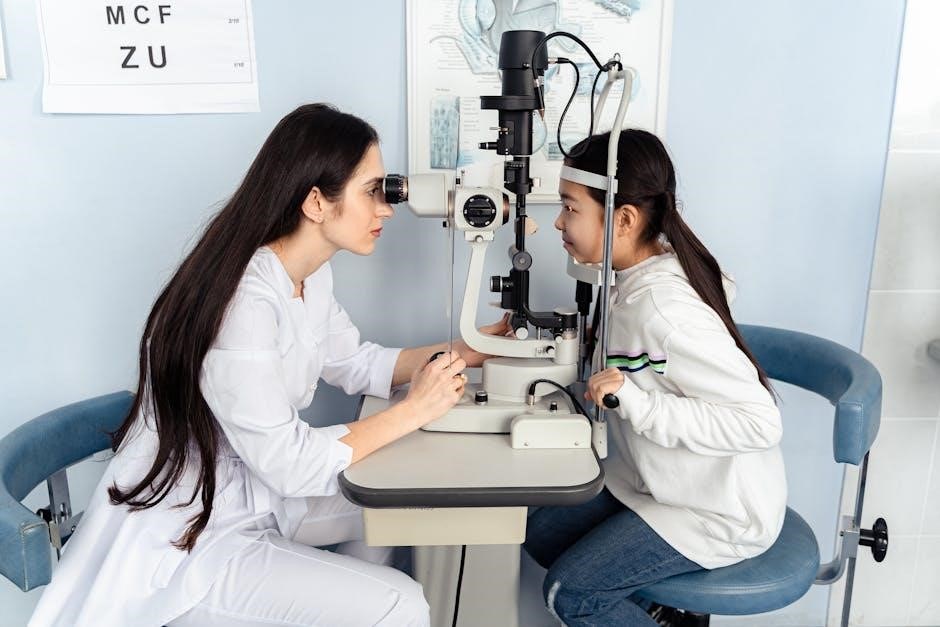
Near vision charts, frequently utilized in PDF format during comprehensive eye examinations, are essential for evaluating a patient’s ability to focus on close-up objects. Optometrists and ophthalmologists employ these charts to detect subtle vision impairments that might not be apparent during distance vision testing.
The assessment helps identify issues like presbyopia, a common age-related condition affecting near sight, and can also reveal early signs of other ocular problems. Utilizing a standardized PDF chart ensures consistency and allows for accurate tracking of any changes in visual acuity over time. This component of the exam is vital for maintaining overall eye health and prescribing appropriate corrective lenses, if needed.
Monitoring Vision Changes
Near vision charts, conveniently accessible as PDF documents for home or clinical use, play a crucial role in tracking alterations in close-up visual acuity. Regular self-monitoring, using a printed PDF chart, can help individuals detect gradual declines in reading ability or focus.
Comparing results over time – documenting scores from repeated tests with the same PDF chart – allows for the identification of trends. This is particularly important for individuals with conditions like diabetes or those experiencing age-related vision changes. Any noticeable deterioration should prompt a visit to an eye care professional for a thorough evaluation and potential intervention.
Screening for Presbyopia
Near vision charts, easily downloaded as PDF files, are invaluable for initial screening of presbyopia – the age-related loss of near focusing ability. As individuals approach their 40s, they may notice increasing difficulty reading small print. Utilizing a PDF near vision chart allows for a simple, at-home assessment of this developing condition.
Difficulty reading the smaller lines on the chart, even with adequate lighting and proper viewing distance, can indicate the onset of presbyopia. While a PDF chart isn’t a substitute for a professional exam, it can signal the need for one, leading to appropriate corrective lens prescriptions like reading glasses or bifocals.
Limitations of Self-Testing
PDF near vision charts offer a basic screening, but aren’t replacements for professional exams. Inaccurate results are possible due to improper technique or lighting.
Importance of Professional Eye Exams
While near vision chart PDFs can provide a preliminary self-assessment, they should never substitute a comprehensive eye examination conducted by a qualified eye care professional. A professional exam involves a multitude of tests beyond simple visual acuity, evaluating overall eye health, detecting underlying conditions like glaucoma or macular degeneration, and assessing binocular vision.
An optometrist or ophthalmologist can accurately diagnose any vision problems and prescribe appropriate corrective lenses or treatments. Self-testing with a downloaded chart lacks the precision and thoroughness of a professional evaluation. Regular eye exams are vital, especially for children, as early detection and intervention can prevent vision impairment and support healthy visual development. Don’t rely solely on PDF charts; prioritize professional care.
Potential for Inaccurate Results
Utilizing a near vision chart PDF for self-testing carries a significant risk of inaccurate results. Factors like improper lighting, incorrect viewing distance (crucially 14 inches/35cm), and subjective interpretation of letters can skew outcomes. Individuals may misjudge their acuity, especially if unfamiliar with proper testing procedures.
Furthermore, the quality of the printed PDF chart itself can impact accuracy – scaling issues or poor print resolution can distort the letters. Pre-existing eye conditions or variations in individual perception can also contribute to errors. Therefore, self-assessment should be considered a screening tool only, not a definitive diagnosis. Always confirm findings with a professional.
When to Consult an Eye Doctor
If a near vision chart PDF self-test reveals consistently blurry vision, difficulty reading smaller text, or any noticeable changes in visual acuity, promptly consult an eye doctor. Don’t rely solely on self-assessment; professional evaluation is crucial.
Specifically, seek medical attention if vision problems develop suddenly, are accompanied by pain, or interfere with daily activities. Regular comprehensive eye exams are vital, even without noticeable issues, to detect and address underlying conditions like presbyopia. A doctor can provide an accurate diagnosis and personalized treatment plan, ensuring optimal eye health beyond what a simple PDF chart can offer.

Resources for Further Information
PDF charts are a starting point; explore the International Centre for Eye Health and Community Eye Health Journal for detailed vision insights.
International Centre for Eye Health
The International Centre for Eye Health (ICEH) stands as a pivotal global resource for comprehensive eye care knowledge. Their website provides a wealth of information, extending beyond simply offering downloadable near vision chart PDFs. ICEH focuses on strengthening capacity in eye health across the world, particularly in low and middle-income countries.
You’ll find research publications, training materials, and practical guidance on various eye conditions and screening methods. Articles from their associated publication, the Community Eye Health Journal, are readily accessible, offering valuable insights into public health approaches to vision care. While they don’t directly host printable charts, understanding the broader context of eye health, as presented by ICEH, enhances the proper interpretation and application of any PDF near vision chart used for self-screening or preliminary assessments.
Community Eye Health Journal
The Community Eye Health Journal, linked with the International Centre for Eye Health, is a freely accessible, peer-reviewed resource. While not a direct repository for near vision chart PDF downloads, it provides crucial context for understanding vision screening and assessment. Articles detail effective strategies for implementing eye care programs in diverse settings.
Content covers topics like prevalence of refractive errors, best practices for visual acuity testing (including near vision), and the importance of early detection. Accessing articles related to near vision assessment enhances the understanding of how to correctly utilize a PDF chart, interpret results, and recognize when professional evaluation is necessary. The journal emphasizes a public health approach, promoting equitable access to quality eye care globally.

Online Vision Screening Tools
Numerous websites offer interactive near vision screening tools, often complementing downloadable near vision chart PDF resources. These digital assessments can provide a preliminary indication of visual acuity, though they shouldn’t replace a comprehensive eye exam. Many tools simulate the experience of using a standard chart, presenting lines of text to identify the smallest readable size.
However, reliance solely on online tools is discouraged due to potential inaccuracies stemming from screen resolution, viewing distance variations, and individual interpretation. These tools are best utilized as a quick self-check, prompting further investigation with a professional if concerns arise. Always prioritize a qualified optometrist or ophthalmologist for accurate diagnosis and treatment.