Area and perimeter are fundamental geometric concepts crucial for understanding spatial relationships, offering insights into shapes and their measurements.
Visual aids, like diagrams, are illustrative and may not be perfectly to scale, requiring careful interpretation during calculations and problem-solving.
Resources, such as downloadable PDFs and online tools, provide convenient access to formulas and calculators for various shapes, enhancing learning.
What are Area and Perimeter?
Area represents the two-dimensional space enclosed within the boundaries of a shape, measured in square units – think square inches, square meters, or square feet. It essentially tells us how much surface a shape covers.
Perimeter, on the other hand, is the total distance around the outside of a two-dimensional shape. It’s calculated by adding up the lengths of all its sides, expressed in linear units like inches, meters, or feet.
Understanding these concepts is vital because they aren’t just abstract mathematical ideas. They have practical applications in everyday life, from calculating the amount of carpet needed for a room (area) to determining the length of fencing required for a garden (perimeter). Diagrams used to illustrate these concepts are often not drawn to scale, so relying on precise measurements is key.
Furthermore, readily available resources like downloadable PDFs containing formulas for all shapes, and online calculators, simplify these calculations, making geometry more accessible.
Why are Area and Perimeter Important?
Area and perimeter are foundational skills with widespread practical applications extending far beyond the classroom. Consider home improvement: calculating paint needed (area) or fencing a yard (perimeter) relies directly on these concepts.
In construction, accurate area calculations are crucial for flooring, tiling, and roofing, while perimeter measurements are essential for framing and foundation work. Even seemingly simple tasks, like determining fabric needed for a sewing project, utilize these principles.
Moreover, understanding area and perimeter fosters spatial reasoning and problem-solving abilities. Resources like downloadable PDFs with formulas for various shapes, and accessible online calculators, empower individuals to tackle real-world challenges confidently. Remember that illustrative diagrams aren’t always to scale, emphasizing the importance of precise calculations.
These skills are also vital in fields like architecture, engineering, and landscaping, demonstrating their enduring relevance.
Basic 2D Shapes ⎯ Formulas & Calculations
Exploring fundamental shapes – squares, rectangles, triangles, parallelograms, and rhombuses – unlocks essential area and perimeter calculations, aided by readily available formula PDFs.
Square: Area and Perimeter
A square, defined by four equal sides and four right angles, presents straightforward calculations for both area and perimeter. Let ‘s’ represent the length of one side of the square.
The perimeter, representing the total distance around the square, is simply calculated as the sum of all four sides: Perimeter = 4 * s. This is because all sides are equal in length.
The area, representing the space enclosed within the square, is found by multiplying the length of one side by itself: Area = s * s or s2. This reflects the square’s two-dimensional extent.
Numerous resources, including downloadable PDFs, provide these formulas for quick reference. Understanding these basic calculations is foundational for tackling more complex geometric problems involving squares and other shapes. Visual aids often accompany these formulas to enhance comprehension.
Rectangle: Area and Perimeter
A rectangle, characterized by two pairs of equal sides and four right angles, offers slightly more nuanced calculations than a square. Let ‘l’ represent the length and ‘w’ represent the width of the rectangle.
The perimeter, the total distance around the rectangle, is calculated by adding all four sides together: Perimeter = 2 * l + 2 * w. This accounts for the two lengths and two widths.
The area, the space enclosed within the rectangle, is determined by multiplying the length by the width: Area = l * w. This provides a measure of the rectangle’s two-dimensional size.
Many downloadable PDFs and online resources conveniently present these formulas. Mastering these calculations is essential for solving practical problems involving rectangular shapes. Diagrams are often included for visual clarity, aiding in understanding the concepts.
Triangle: Area and Perimeter
Calculating the area and perimeter of a triangle depends on the information available. The perimeter, representing the total length of all sides, is straightforward: Perimeter = a + b + c, where a, b, and c are the lengths of the three sides.
However, determining the area requires different approaches. The most common method utilizes the base and height: Area = 0.5 * base * height. The height must be perpendicular to the base.
Alternatively, Heron’s formula provides a solution when all three sides are known, but the height isn’t. It involves calculating the semi-perimeter (s = (a+b+c)/2) and then applying: Area = √(s(s-a)(s-b)(s-c)).
Numerous PDFs and online tools offer these formulas for quick reference. Visual aids, like diagrams, are crucial for understanding base and height relationships.
Using Base and Height
The most fundamental method for calculating a triangle’s area relies on knowing its base and corresponding height. The base can be any side of the triangle, but the height must be the perpendicular distance from the base to the opposite vertex.
This perpendicularity is crucial; a slanted line won’t yield the correct area. The formula is remarkably simple: Area = 0.5 * base * height, or equivalently, (base * height) / 2.
Understanding this concept is foundational for more complex geometric calculations. Diagrams are incredibly helpful in visualizing the base and height, especially in obtuse triangles where the height might fall outside the triangle itself.
Many downloadable PDFs and online calculators utilize this formula, providing a quick and easy way to determine the area when base and height are known. Remember accuracy in measurements is key!
Using Heron’s Formula
When the base and height of a triangle aren’t readily available, Heron’s Formula provides a powerful alternative for calculating its area. This formula elegantly utilizes only the lengths of the three sides – let’s call them a, b, and c.
First, calculate the semi-perimeter, denoted as ‘s’, which is simply (a + b + c) / 2. Then, the area is calculated as the square root of [s * (s ─ a) * (s ⎯ b) * (s ⎯ c)].
Heron’s Formula is particularly useful for triangles where finding the height is difficult or impractical. Numerous online resources and downloadable PDFs offer step-by-step guides and calculators implementing this formula.
Accuracy in side length measurements is vital for precise area determination. Visualizing the triangle and correctly identifying side lengths are crucial steps before applying the formula.
Parallelogram: Area and Perimeter
A parallelogram, characterized by opposite sides that are parallel and equal in length, requires distinct formulas for calculating its area and perimeter. The perimeter is straightforward: simply sum the lengths of all four sides. Since opposite sides are equal, this simplifies to P = 2(a + b), where ‘a’ and ‘b’ represent the lengths of adjacent sides.
Calculating the area, however, necessitates knowing the base and height. The area is found by multiplying the base length by the perpendicular height (Area = base * height). It’s crucial to remember that the height isn’t the length of the sloping side.
Downloadable PDFs and online calculators readily provide these formulas, aiding in quick and accurate calculations. Diagrams are illustrative and may not be to scale, so careful attention to labeled dimensions is essential.
Rhombus: Area and Perimeter
A rhombus, a quadrilateral with all four sides equal in length, presents unique considerations when determining its area and perimeter. The perimeter calculation is exceptionally simple: since all sides are equal, multiply the length of one side by four (P = 4s, where ‘s’ is the side length).
The area calculation offers two primary methods. One involves knowing the base and height, similar to a parallelogram – Area = base * height. The other utilizes the diagonals. If ‘d1’ and ‘d2’ represent the lengths of the diagonals, the area is calculated as (1/2) * d1 * d2.
Numerous resources, including downloadable PDFs, offer these formulas for easy reference. Remember that illustrative diagrams aren’t always drawn to scale, so precise measurements are vital for accurate results.

Circles ⎯ Formulas & Calculations
Circles possess unique properties, demanding specific formulas for area and circumference (perimeter). Online tools and PDFs simplify these calculations effectively.
Circle Area Formula
Calculating the area of a circle requires understanding its fundamental relationship with its radius. The area, representing the space enclosed within the circle’s circumference, is determined using the formula: Area = πr², where ‘π’ (pi) is a mathematical constant approximately equal to 3.14159, and ‘r’ represents the radius of the circle.
The radius is the distance from the center of the circle to any point on its edge. Therefore, to find the area, you must first know the radius. If you are given the diameter (the distance across the circle through its center), simply divide the diameter by two to obtain the radius.
Numerous online calculators and downloadable PDF resources provide quick and accurate area calculations, eliminating the need for manual computation. These tools are particularly helpful when dealing with complex problems or when precision is paramount. Remember that the units of area will be squared (e.g., square centimeters, square inches).
Circle Circumference (Perimeter) Formula
Determining a circle’s circumference – its perimeter – involves a similarly straightforward formula. The circumference, representing the total distance around the circle, is calculated using: Circumference = 2πr or, equivalently, Circumference = πd, where ‘π’ remains the constant approximately equal to 3.14159, ‘r’ is the radius, and ‘d’ is the diameter.
Using the diameter is convenient if that measurement is directly provided. Otherwise, calculate the radius from the diameter by dividing it by two. Understanding this relationship is key to accurate calculations.
Many readily available resources, including downloadable PDFs and online calculators, simplify circumference calculations. These tools are invaluable for verifying results and tackling more complex geometric problems. Ensure your units are consistent; the circumference will be in the same units as the radius or diameter (e.g., centimeters, inches).

Polygons ⎯ Formulas & Calculations
Polygons, with their varied sides, require specific approaches for area and perimeter. Regular polygons utilize simpler formulas than irregular ones.
Regular Polygons: Area and Perimeter
Regular polygons possess equal sides and angles, simplifying calculations significantly. The perimeter is easily determined by multiplying the length of one side by the number of sides (n). For instance, a pentagon with sides of 5cm has a perimeter of 25cm.
Calculating the area involves a slightly more complex formula: Area = (n * s2) / (4 * tan(π/n)), where ‘n’ represents the number of sides and ‘s’ is the side length. Alternatively, the area can be found using the apothem (the distance from the center to the midpoint of a side).
Area = (1/2) * perimeter * apothem. Understanding these formulas, alongside readily available online calculators and downloadable PDFs, empowers accurate determination of area and perimeter for regular polygons, crucial in various geometric applications.
Irregular Polygons: Area and Perimeter (Approximation Methods)
Irregular polygons, lacking equal sides or angles, necessitate approximation methods for area and perimeter calculations. Determining the perimeter is straightforward: simply sum the lengths of all sides. However, calculating the area presents a greater challenge.
One common method involves dividing the irregular polygon into smaller, manageable shapes – triangles and rectangles – whose areas are easily calculated. Summing these individual areas provides an approximation of the polygon’s total area.
Another technique utilizes coordinate geometry, employing formulas based on the vertices’ coordinates. Online tools and downloadable PDFs often provide these formulas. Remember, these methods yield approximations; accuracy increases with finer subdivisions or precise coordinate data. Careful consideration of scale, as diagrams aren’t always accurate, is vital.
3D Shapes ⎯ Surface Area & Volume (Brief Overview)
Three-dimensional shapes extend area and perimeter concepts to surface area and volume, requiring distinct formulas for calculations, as seen in downloadable resources.
Cube: Surface Area and Volume
A cube, a regular hexahedron, possesses six identical square faces, simplifying its surface area and volume calculations. The surface area, representing the total area of all its faces, is determined by the formula 6a², where ‘a’ denotes the length of one side.
Calculating the volume of a cube is equally straightforward, achieved by cubing the side length – a³. This means multiplying the side length by itself three times. Both formulas are readily available in comprehensive area and perimeter formula PDFs.
Understanding these formulas is crucial for solving practical problems involving cubic structures. Remember that consistent units are essential for accurate results. Online calculators and tools can also assist in verifying calculations and exploring different scenarios.
Rectangular Prism: Surface Area and Volume
The rectangular prism, characterized by six rectangular faces, requires a slightly more complex calculation than a cube; Its surface area is found by summing the areas of all six faces: 2(lw + lh + wh), where ‘l’ represents length, ‘w’ width, and ‘h’ height.
Determining the volume of a rectangular prism is simpler, calculated as the product of its length, width, and height: lwh. These formulas are commonly included in area and perimeter formula PDFs for easy reference.
Practical applications abound, from calculating the amount of material needed to construct a box to determining the capacity of a container. Accurate measurements and consistent units are vital for precise results. Utilize online tools to double-check your work and explore various dimensions.
Cylinder: Surface Area and Volume
The cylinder, featuring two circular bases and a curved surface, presents unique calculations. Its surface area comprises the areas of the two circles (2πr²) plus the lateral surface area (2πrh), resulting in the formula: 2πr² + 2πrh, where ‘r’ is the radius and ‘h’ the height.
Calculating the volume of a cylinder is straightforward: πr²h. This formula, alongside the surface area calculation, is frequently found within comprehensive area and perimeter formula PDFs. Understanding the role of π (pi) is crucial for accurate results.
Real-world examples include determining the material needed for a can or calculating the volume of a water tank. Remember to maintain consistent units throughout your calculations for precision. Online calculators can assist in verifying your answers.

Practical Applications & Problem Solving
Area and perimeter concepts are vital for real-world tasks, like fencing a garden or flooring a room, utilizing formulas from PDFs.
Carefully avoid common calculation errors by double-checking units and applying the correct formula for each shape.
Real-World Examples of Area and Perimeter Calculations
Imagine designing a garden: Determining the perimeter helps calculate the fencing needed, while the area dictates the amount of soil or seeds required – all utilizing formulas readily available in a comprehensive shapes PDF.
Consider home improvement: Calculating the area of a wall is essential for wallpapering or painting, and the perimeter aids in determining the length of baseboards. These practical applications demonstrate the everyday relevance of these geometric concepts.
For construction projects: Builders use these calculations constantly – from laying foundations (area) to erecting walls (perimeter). Accurate measurements, guided by formula sheets, are paramount for structural integrity and material efficiency.
Even simple tasks like framing a picture or covering a table require understanding area and perimeter. Accessing a readily available PDF containing all necessary formulas streamlines these processes, ensuring accuracy and saving time.
These examples highlight how fundamental geometric principles translate into tangible, real-world solutions.
Common Mistakes to Avoid
A frequent error involves confusing area and perimeter – remembering that area measures surface while perimeter measures distance around is crucial. Always double-check which measurement the problem requires!

Units are often overlooked: Ensure consistent units throughout calculations (e.g., all measurements in centimeters or meters). Mixing units leads to incorrect results. A good shapes PDF will often emphasize unit consistency.
Incorrect formula application is another common pitfall. Carefully select the appropriate formula based on the shape. Referencing a reliable formula sheet, like a downloadable PDF, minimizes this risk.
For complex shapes, breaking them down into simpler components before calculating area or perimeter can prevent errors. Visualizing the decomposition aids understanding.
Always verify your answer’s reasonableness. Does the calculated value seem logical in the context of the problem? Careful attention to detail avoids these pitfalls.

Resources & Further Learning
Downloadable PDFs offer convenient formula references, while online calculators simplify calculations for various shapes, aiding comprehension and problem-solving practice.
Downloadable Area and Perimeter Formula PDF
Accessing a comprehensive PDF containing area and perimeter formulas for all common shapes is an invaluable learning tool. These readily available resources consolidate essential information in a portable, easily accessible format, perfect for study and quick reference.
Many educational websites and platforms offer free, downloadable PDFs covering squares, rectangles, triangles, circles, parallelograms, rhombuses, and various polygons. These PDFs typically include clear diagrams illustrating each shape alongside its corresponding formulas.
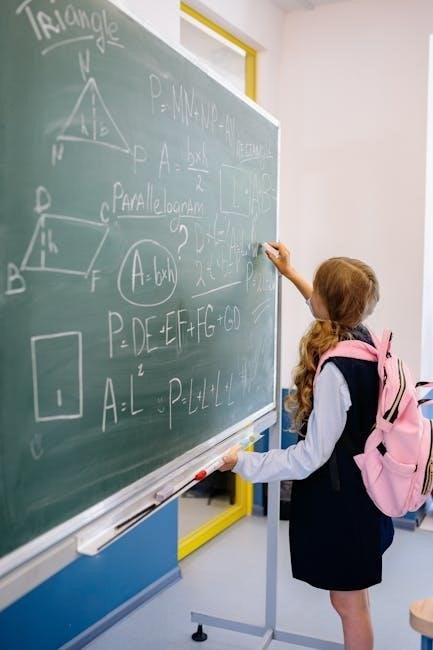
Furthermore, some PDFs extend beyond basic 2D shapes, briefly introducing surface area and volume formulas for 3D objects like cubes, rectangular prisms, and cylinders. A well-structured PDF will often categorize formulas by shape type, making it simple to locate the specific equation needed for a given problem. Look for PDFs designed for upper KS2 students or introductory geometry courses for optimal clarity and relevance.
Online Calculators and Tools
Numerous online calculators and interactive tools simplify area and perimeter calculations, offering a convenient alternative to manual computation. These digital resources are particularly helpful for verifying answers and exploring complex shapes.
Websites dedicated to mathematics often provide specialized calculators for individual shapes, allowing users to input dimensions and instantly obtain area and perimeter values. Some tools even offer step-by-step solutions, demonstrating the application of relevant formulas.
Beyond basic calculators, interactive geometry software enables users to visualize shapes, manipulate dimensions, and observe the resulting changes in area and perimeter in real-time. These tools can significantly enhance understanding and problem-solving skills. Searching for “area and perimeter calculator” or “geometry tools” will yield a wide range of options, catering to various learning styles and needs.